I've come to learn that there are two approaches to doing taping and mudding (plastering). One method is to get the stuff on there as quickly as possible and then sand like crazy. The other method is to take your time and apply the plaster as thinly as possible, gradually building up the wall surface. While this takes more time, the end result requires a lot less sanding. So far, my results are coming out quite nicely and I don't see myself standing in a cloud of drywall dust in the near future.
The drywall compound that I'm using is a pre-mix variety that has dust control propertires (http://www.cgcinc.com/home.asp?nav=291&mkt=30&bc=165.291). So hopefully, when it comes time to start sanding, however little it may be, the dust won't be out of control.
Here's a few tips:
- Thin down the mud with water. A consistency of soft ice cream works really well. You want the mud to flow into the depressions when you run the knife over it and not pull itself back out as thick mud would. I'll probably thin the mud even more when I get to the very final coats.
- Get three different sizes of knives. I'm using 4.5, 10, and 12 inch knives. If you understand the geometry, you'll understand why you need the larger knife. I suppose you could just use the 4.5 inch but it would be more work to get the smooth results.
- Wetting the paper tape and knives with water gives a smoother stroke.
That's all for now...


 Looking towards the back of the theatre from the left (top) and centre (bottom). The front of the bar is visible in the back.
 Behind the front of the bar. I didn't need to complete all of the drywall because the exposed framing will be hidden by cabinets. I sound-proofed the left corner of the bar to reduce noise coming from the compact refrigerator that will be placed there.


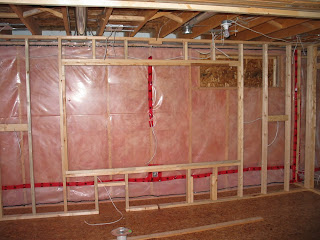 The projector screen wall with wires for left, centre, right speakers and subwoofer.
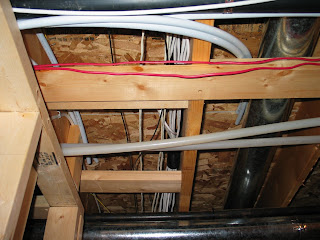 Bundle of wires running from the utility room. They include speaker wires, CAT-5 for the sensors, and microphone cables.
 The rough-in for temperature and light sensor (on left) and the microphone installed in the kitchen. These microphones were designed originally to be used for conference rooms and are sensitive to human vocal frequencies which makes them ideal for voice recognition applications. For the temperature and ambient light sensor, I'll drill tiny holes in the plate and install the sensors in the wall behind it.